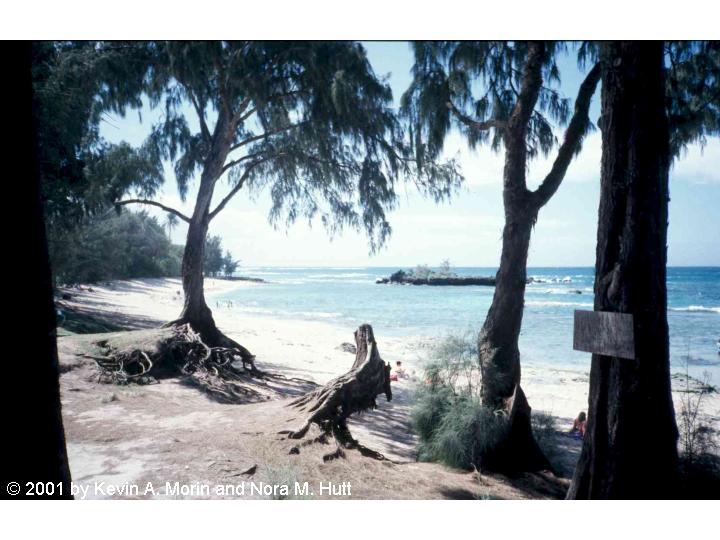
 Photo 1. Oahu Coastline (click to enlarge).
 Photo 2. A Moray Eel
(click to enlarge).
Photo 2. A Moray Eel
(click to enlarge).
Trip Report
Hawaii, USA - February-March 2001
© copyright 2001 by K. Morin and N. Hutt,
Marine Documentation & Analysis Group (MDAG)
Preamble: We have noticed a number of people laugh when we explain that monitoring of the marine
environment is critical in a "paradise" like Hawaii. They laugh because they think our work is a "cover"
for vacation. And that really is a telling observation. So many think of tropical marine environments
as laid-back and unstressed, so why worry? What environmental harm can thousands
and millions of tropical tourists each year do? It is for that exact reason that we do this work.
This lack of concern easily leads to needless environmental destruction, because people do
not like to ponder the environmental consequences of their tropical
vacations. On this last trip, we did not sit around a pool or sunbathe
even once - there was too much important work to do.
Off Waikiki, Oahu
On this trip, we spent some time on Oahu. We have documented in past trips the lack of live and colourful coral off southern portions of this island, presumably due to the many decades of industrial and tourist activity. This is not to say that the entire ecosystem is dead. For example, while snorkelling off the Hilton Hawaiian Village (Waikiki) in 1998, most of the coral was dead and broken, but there were a few patches of live coral and one small brain-coral mound. Around this coral mound, we also noticed various wrasses, goatfish, Moorish Idols, and a baby scorpionfish. So there were small aquatic ecosystems hanging in there, short distances away from a million of human beings. Elsewhere during that snorkel, we also saw lots of small puffers and porcupinefish, seas cucumbers, a baby flounder, a flying gurnard, and only a few urchins. What did not make sense was the legal fishing schedule that allowed fishing in these strongly impacted areas every second year.
So we returned to this area off the Hilton Hawaiian Village this year (2001), three years after our previous snorkel. There was not much different, with only a few patches of live coral and few fish. The small coral mound had fewer fish this time, however. An interesting encounter had three small squids, about 0.3 m long, curious about us and following us around for awhile.
Photo 1. Oahu Coastline (click to enlarge).
Photo 2. A Moray Eel
(click to enlarge).
Hanauma Bay, Oahu
One objective of this trip was to visit Hanauma Bay, located about a 30-minute drive east of Waikiki. This is a beautiful, shallow, crescent-shaped bay, formed by the breaching of one side of a volcanic cone by the ocean (see Figure 1). Being so beautiful and close to Waikiki, Hanauma Bay has received approximately two million visitors per year since at least 1980, with smaller numbers before 1980. Millions of people came here, walked on the coral, and overfed the fish that would swarm around anybody offering free food. The result: mostly dead coral, an unbalanced fish population based on overabundant food, and some demands for environmental protection and management.
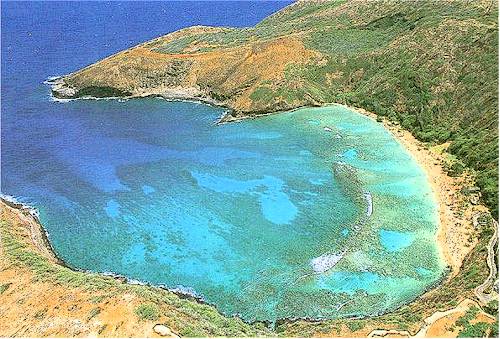
Photo 3.
Stock Photograph of Hanauma Bay, Oahu (click to enlarge).
When we snorkelled Hanauma Bay in 1997 to observe the impacts, we saw the widespread dead coral and people still walking on coral with shoes. There were many large parrotfish, which were apparently strong enough to beat other fish to free food, some Moorish Idols, wrasses, and even some humunukunukapua'a (a personal favourite because of its colouring). However, others have reported 420 species of tropical fish in the bay, which seems amazing to us, and there is a pictorial book available entitled Exploring Hanauma Bay by Susan Scott (try www.amazon.com or www.booklineshawaii.com/BOOK/BGB/814940.html if you are interested).
Since then, a great deal of effort and enforcement has been expended on getting the Bay back
into some kind of natural balance. For several years now, commercial scuba diving has been limited
under permits to only a few operators with small groups. For all visitors, there are now hefty fines
up to $1000 or 30 days in jail for feeding fish. An environmental-impact assessment was completed
to determine the impacts of limiting people and fish feeding. This assessment indicated there would
be no massive die-off when the feeding was terminated, but a slow readjustment to greater diversity
and smaller sizes which would also affect the feeding pattern of eels. You can read more at:
http://www.soest.hawaii.edu/SEAGRANT/CRM/CEH2C.html and
http://http://cramp.wcc.hawaii.edu/Study_Sites/Oahu/Hanauma_Bay/Time_Line.asp
and
www.epa.gov/cookbook/page68.html
Or call the 24-hour information line at 1-808-396-4229.
Interestingly, park and parking fees are generating a few million dollars a year, but there appears some argument on how to apply that money to the bay.
During this visit to Oahu, we decided to dive the outer portions of Hanauma Bay. Because of the currents, difficulty in moving equipment to the outer areas, and to increasing regulations, we decided to dive with one of the few permittees allowed to do so. The only one we could locate was "Jinji" (1-808-732-7374), who comes highly recommended and is very helpful on the phone. Unfortunately, we could not dive the Bay because (1) the heavy trade winds caused high waves from the east into the Bay for several days, (2) no diving is allowed on weekends, (3) the Monday we had available was a holiday and diving is not allowed on holidays, (4) the park is closed completely on Tuesday and (5) jellyfish had been spotted in the bay recently. That ruined our window of opportunity. Jinji felt bad for us, but promised to take us "next time".
The Leeward (West) Coast of Oahu
When waves are high on the east side of the Hawaiian Islands, the waves on the west side are sometimes very low, which is unusual during winter months. We took advantage of the rare opportunity to dive the west side near Waianae and Makaha.
We last dove this area in 1997, over three years ago. So we were anxious to check the status of the underwater environment again. This area is not a major tourist destination and is mostly populated by local people and native Hawaiians.
After renting tanks at Ocean Concepts in the nearby town of Waianae, we drove to Kahe Point, also known as Electric Beach, across the highway from the large power-generating station. What was once a lesser known dive site was amazingly popular - lots of recreational divers, spearfishers, and scuba classes. Weighted coloured ropes lay across the bottom in places. The effect? We saw less fish than in 1997.
Despite the fewer numbers, many fish still enjoy the "thrill ride" at the submerged six-foot-diameter outlet of the power-plant cooling system. The warm water rushes out of the pipe at a fast pace. So fish try to swim into it, holding their own for awhile, then relaxing and tumbling away in the current. It must be the fish version of an amusement park. We were at least willing to put our fins into the current, which then twisted us around a few times. Perhaps you have to be a fish to really appreciate it.
We did not repeat our 1997 species-to-species encounter with a octopus this time, but we did spot some large Moorish Idols, trumpetfish, and pufferfish. We also came across one turtle.
%20018%20Divers.jpg) Photo 4. Divers at Kahe Point (click to enlarge).
Photo 4. Divers at Kahe Point (click to enlarge).
%20027%20Trumpetfish.jpg) Photo 5. A Trumpetfish at Kahe Point (click to enlarge).
Photo 5. A Trumpetfish at Kahe Point (click to enlarge).
%20012%20Stonefish.jpg) Photo 6. A Stonefish in the Sand at Kahe Point (click to enlarge).
Photo 6. A Stonefish in the Sand at Kahe Point (click to enlarge).
The Kona Coast, Big Island (Hawaii)
After flying to the Big Island, we returned to one of the best sites in Hawaii - Honaunau Bay about a half hour south of Kailua-Kona. Because it often has many divers, snorkellers, and sun bathers, we keep close track of the environmental status of this site.
We dive or snorkel this bay almost every year or two, and October 1999 was our last visit. The fish and coral have always been vibrant and it was no different this time. As usual, the visibility was great (up to 30 m) and only minor surface chop, but water temperature was a bit cooler than in many past visits (25oC).
The evidence for the ongoing health and growth of this ecosystem is all around. For example, some large cinder blocks were dropped on coral many years ago, and crushed the coral. But now new coral is growing on top of the blocks, and dead tips of nearby finger coral have new growth.
The green sea turtles have been legally protected for some years now in Hawaii, and the results are clear. The number of turtles we see climbs every year, and they are increasingly less shy and fearful of humans. A human can approach within a foot of the turtles if no threatening or harassing actions are made.
We have heard whales before in Honaunau Bay, and did again this time. Although we could not see the whale, people at the surface said it was breaching nearby. It would take too much space to list all the fish we saw, but Potter's Angelfish are relatively unusual here and the flocks of raccoon butterflyfish are always interesting to follow.
%20001%20to%20Bay.jpg) Photo 7. On the Way to Honaunau Bay, Big Island of Hawaii (click to enlarge).
Photo 7. On the Way to Honaunau Bay, Big Island of Hawaii (click to enlarge).
%20009%20Coral.jpg) Photo 8. Coral at Honaunau Bay (click to enlarge).
Photo 8. Coral at Honaunau Bay (click to enlarge).
%20036%20Turtle.jpg) Photo 9. A Turtle at Honaunau Bay (click to enlarge).
Photo 9. A Turtle at Honaunau Bay (click to enlarge).
%20006%20Urchin.jpg) Photo 10. Coral and an Urchin at Honaunau Bay (click to
enlarge).
Photo 10. Coral and an Urchin at Honaunau Bay (click to
enlarge).
We snorkelled a new site this time - Kahaluu (Keauhou) Beach Park. This site is shallow, mostly less
than 1 m, with only a few patches of live coral. But the fish are abundant and not too shy,
apparently because they are used to handouts by humans (see the discussion on Hanauma Bay
above). There were a few turtles around, even sunning themselves on the rocky
shore. We were surprised to see several rockmover wrasses
(both adults and the leaf-like juvenile), as well as numerous needlefish hanging out near the surface.
%20024%20Moorish.jpg) Photo 11. A Moorish Idol at Kahaluu Beach Park (click to enlarge).
Photo 11. A Moorish Idol at Kahaluu Beach Park (click to enlarge).
%20004%20Turtle%20Face.jpg) Photo 12. A Curious Turtle at Kahaluu Beach Park (click to enlarge).
Photo 12. A Curious Turtle at Kahaluu Beach Park (click to enlarge).
%20006%20Needlefish.jpg) Photo 13. A Needlefish Just Below the Water’s Surface at Kahaluu Beach Park (click to enlarge).
Photo 13. A Needlefish Just Below the Water’s Surface at Kahaluu Beach Park (click to enlarge).
%20013%20Milletseed.jpg) Photo 14. A Milletseed Butterfly Fish at Kahaluu Beach Park (click to enlarge).
Photo 14. A Milletseed Butterfly Fish at Kahaluu Beach Park (click to enlarge).
%20028%20Swarm.jpg) Photo 15. A Fish Swarm at Kahaluu Beach Park (click to enlarge).
Photo 15. A Fish Swarm at Kahaluu Beach Park (click to enlarge).
%20004%20Close%20Puffer.jpg) Photo 16. A VERY Curious Pufferfish at Kahaluu Beach Park (click to enlarge).
Photo 16. A VERY Curious Pufferfish at Kahaluu Beach Park (click to enlarge).
%20018%20Puffer%20Smile.jpg) Photo 17. A Friendly Smile at Kahaluu Beach Park (click to enlarge).
Photo 17. A Friendly Smile at Kahaluu Beach Park (click to enlarge).
%20033%20Fish%20Facing.jpg) Photo 18. And More Curiosity at Kahaluu Beach Park (click to enlarge).
Photo 18. And More Curiosity at Kahaluu Beach Park (click to enlarge).
%20026%20Turtle%20Rest.jpg) Photo 19. A Parting Turtle Picture from Kahaluu Beach Park (click to enlarge).
Photo 19. A Parting Turtle Picture from Kahaluu Beach Park (click to enlarge).
Return to Home Page
Last Updated on February 16, 2002 by MDAG.com